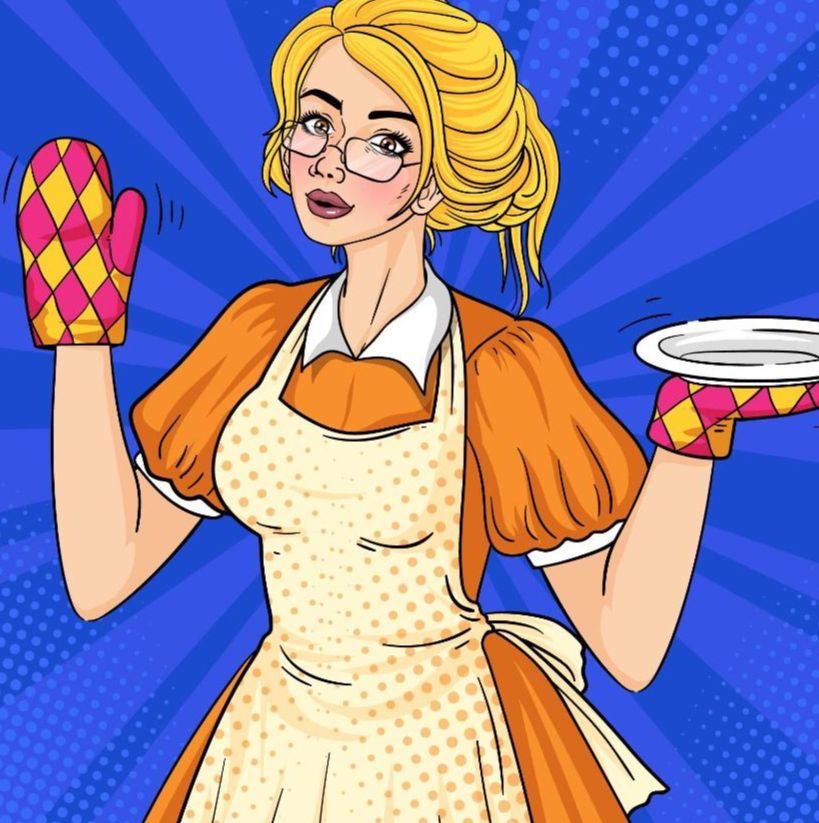
In the Fifties and Sixties, my mom was hardly a Trad Wife: she had fallen in love and married, yes…and then she constantly worked because we couldn’t get by on my father’s salary as a subway worker. She also hated household maintenance, and had no interest (or competence) in the joys of “making food from scratch.” As for home-schooling, her jaw would’ve dropped at the term. At a time when women were not supposed to value a career, my mother would’ve loved to have a career, but had little education. It’s a sad irony that the Trad Wives tend to be well educated, as many Fifties wives weren’t, yet make not working outside the home as their career.
Trad Wives have become so glam recently that the term has spread from social media to deep articles about the meaning of this trend for feminism. This is not surprising: social media diffuses cultural ideas with lightning speed, ideas that are often superficial and oversimplified, meaning they require no knowledge of history, much less critical thinking. The success of the Trad Wives trend is that it’s a performative fantasy of what American women’s supposed life was like in the Fifties and Sixties, except what’s left out is that these were almost always middle-class suburban white women in America, unlike my mother.
Conveniently, the trend of Trad Wives leaves out the real-life context, i.e. how very boring and limited such a life was for many (not all) women. It’s telling that Betty Friedan’s groundbreaking book, The Feminine Mystique, where she wrote about “the problem that has no name”, was a bestseller. Though the Trad Wife life looks satisfying when an influencer copies women’s designated roles in that era, at it’s rotten core, the wife was there to serve the man and family, period. That hardly fits with the gains women have made in education, the workforce, equal parenting, independent living, and so on. Those gains aren’t perfect, but there was a reason that women pressed for them. Do the trendy young women “inspired” by Trad Wife influencers really want to go back to a time when, for just one example, women could not apply for their own credit cards without their husband’s written approval? (This was so deeply rooted that the law giving American women the right to their own credit was not enacted until 1974.)
Ever since feminism began (with Mary Wollstonecraft in the late 18th century in England, and Susan B. Anthony and Elizabeth Cady Stanton in early 19th century in America), there’s been pushback by men, and also some women, against forward change. The political climate now is an example of this: in spite of the enormous gains — politically, economically, socially, individually — that women have made, there’s always a longing for a time when women were “protected” by men, as well as supported financially — because, as the great feminist philosopher Simone de Beauvoir said, freedom is very scary when you’re responsible for your own life. (That’s a paraphrase, not a quote!) But there’s a price to be paid when handing your life over to serving someone else.
I was a stay-at-home wife myself while my children were young and you could still live on one modest salary, but I was hardly Trad – I went back to grad school to get a PhD when my first child was less than two years old, and wrote my dissertation s-l-o-w-l-y for years while I raised two more babies. This was my choice because I wanted to be with my children as much as I could, but my life at home was neither glamorous nor seen as cool by anyone, including me. In fact it was as monotonous as those of the housewives Betty Friedan described. After a year or so, I was eager to get going with my own life, and happier when I was finally able to have the career as an English professor that I’d hoped and planned for. This change was part of what crashed my marriage, but was also the opportunity for me to bloom. I don’t regret it for a moment.
Today, women younger that I am (which is most women) lean toward marrying later, having babies later (if they want them), and firing their careers up while they’re still young and energetic. I would do all of that too if I could do it over again. Nevertheless, though women’s lives have changed enormously, due to more education, more access to careers, more equality in parenting, etc., women still do most of the daily home maintenance and childcare. There’s been some movement toward equalization in family roles, but it’s not as great a change as in those other areas of women’s lives.
This is where the Trad Wives come in: a trend like Trad Wives makes some women feel better about this lag in equality, by reinforcing the conservative role for women as a fun ideal. When glamorized, it looks idyllic, happy, easy, fulfilling, prettified, removing the focus on inequality from the equation. In reality, when there’s one and only one wage-earner, that person intrinsically tends to have more power in the relationship, while women’s work at home is discounted as just “natural”.
Since the conservative ideal of the “traditional” wife has been mainly boosted by influencers who monetize their performances, the underlying “meaning” this brings to their lives seems to me more a cynical ploy to advertise themselves than pastoral romance, whether or not they grind their own flour.
 Susan Ostrov
Leave a Reply